


Clothing is an act of quiet power. In the realm of occasionwear, every design decision, from the drape of the fabric to the precision of the seaming, contributes to the presence of the wearer. Yet, before silhouette or texture registers to the eye, the mind processes hue. Determining the ideal color for an evening dress is arguably the most critical foundational step in curating a formal wardrobe. It is not merely a matter of following seasonal trends or subjective preference; it is a calculated study of proportion, light, and individual complexion.
At HER.I, a womenswear label based in New York, we focus exclusively on occasionwear defined by architectural softness and textural dialogue. Through disciplined construction and deliberate restraint, we believe garments should offer presence without spectacle. From our experience, selecting the right color for an evening dress transforms a garment from a simple article of clothing into an heirloom of personal celebration. When chosen carefully, the color for an evening dress becomes a living element of silhouette memory, echoing the ritual of the event long after the evening concludes.
Table of Contents
- 1. The Psychology and Presence of Color
- 2. Decoding Complexion: Skin Tone and Undertones
- 3. The Influence of Event Lighting and Environment
- 4. Textural Dialogue: How Fabric Alters Hue
- 5. The HER.I Perspective on Formal Dress Codes
- 6. Summary Table: Color Selection Guide
- 7. Frequently Asked Questions
- 8. Industry References
1. The Psychology and Presence of Color
In formal settings where clothing is chosen carefully and worn with purpose, color serves as a non-verbal communicator of intent. The psychological impact of the color for an evening dress dictates the energy the wearer brings into a room. We recommend approaching color selection as an exercise in curating your personal atmosphere. A saturated hue commands immediate attention, while muted, complex tones invite closer inspection and convey deliberate restraint.
Consider the classic midnight blue. As a color for an evening dress, midnight blue offers the formality and depth of black, but with a subtle atmospheric shift that suggests approachability and intellectual depth. Crimson, conversely, is a high-frequency hue that denotes vitality and confidence. It demands disciplined construction to ensure the garment remains sophisticated rather than overwhelming. When deciding on the color for an evening dress, one must ask: what is the intention of the evening? Is the goal to stand out with striking architecture, or to blend seamlessly into a sophisticated gathering with a garment that reveals its brilliance only up close?
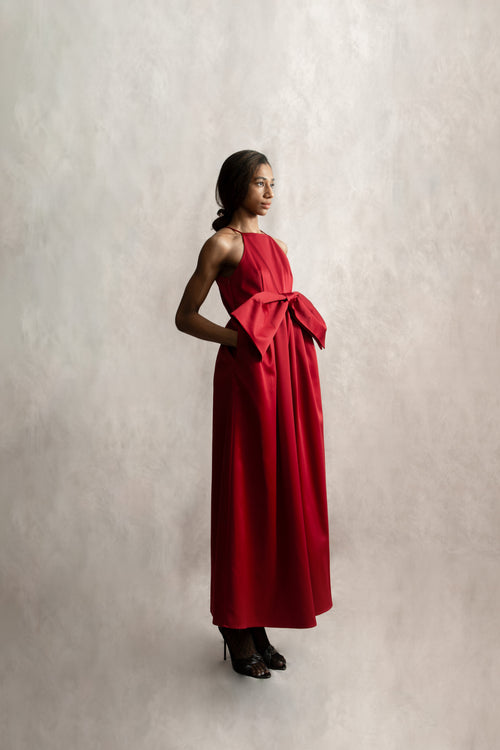
From our experience consulting with private clients for our Dresses Made to Order, the most successful garments are those where the color aligns with the wearer's inherent demeanor. An understated personality might find their quiet power amplified by an austere slate grey or a deep olive green, proving that the most compelling color for an evening dress is often the one that harmonizes with the wearer's psychology rather than competing with it.
2. Decoding Complexion: Skin Tone and Undertones
The technical foundation of choosing a color for an evening dress lies in color theory and human biology. The interaction between the pigment of the fabric and the melanin, carotene, and hemoglobin in the skin determines whether a dress illuminates the wearer or casts undesirable shadows. Understanding undertones is non-negotiable in this process.
Identifying Cool Undertones
Individuals with cool undertones typically possess hints of blue, pink, or ruddy red beneath their skin. Their veins often appear blue or purple under natural light. For these individuals, the optimal color for an evening dress resides on the cooler end of the spectrum. Jewel tones are exceptionally flattering. We recommend exploring deep sapphire, rich emerald, amethyst, and classic ruby. These colors create a striking contrast that brightens the complexion. Conversely, cool undertones should generally avoid pale yellows or muddy oranges, which can render the skin tone sallow.
Identifying Warm Undertones
Warm undertones are characterized by peach, golden, or yellow hues beneath the skin's surface, with veins typically appearing greenish. When selecting a color for an evening dress for warm undertones, earth-inspired and fiery hues yield the most sophisticated results. Rich terracotta, burnt orange, mustard yellow, and warm gold are impeccable choices. In our studio, we often recommend deep bronze or a verdant olive as an alternative to traditional black for clients with warm undertones, as these shades harmonize beautifully with the skin's natural warmth, enhancing the garment's textural dialogue.
Identifying Neutral Undertones
Neutral undertones strike a balance between cool and warm, allowing for a broader spectrum of choices. However, true elegance requires discernment. The most striking color for an evening dress on a neutral complexion is often found in muted, complex shades rather than primary colors. Dusty rose, jade green, and taupe offer a refined palette. We recommend focusing on mid-tones, as overly neon or intensely vibrant shades might overpower the subtle balance of a neutral complexion.
3. The Influence of Event Lighting and Environment
A color does not exist in a vacuum; it is entirely dependent on the light that reflects off it. The ideal color for an evening dress in a naturally lit garden at twilight will behave fundamentally differently under the incandescent chandeliers of a ballroom or the stark, directed halogen lighting of a gala stage. Therefore, understanding the environmental context is crucial.
For events beginning in the late afternoon and transitioning into evening, natural light requires colors that possess organic depth. A dusty lavender or a sage green acts as a beautiful transitional color for an evening dress, catching the golden hour light magnificently. As natural light fades, these colors deepen, adopting a more formal persona.
Conversely, indoor formal galas illuminated by warm incandescent or candlelight demand colors that can absorb and reflect that specific spectrum. In these environments, warm tones like rich burgundy, gold, and deep plum thrive. If you are attending an event with harsh, artificial lighting, such as a televised dinner or an industry award ceremony, saturated, unambiguous colors are preferable. A sharp, clear navy or an uncompromising stark white will maintain its integrity, ensuring the color for an evening dress remains crisp and defined in photographs.
4. Textural Dialogue: How Fabric Alters Hue

At HER.I, our design philosophy is deeply rooted in textural dialogue. We understand that the exact same dye applied to two different fibers will result in two entirely different colors visually. The texture of the fabric dictates how light is absorbed or reflected, fundamentally altering the perception of the color for an evening dress.
Silk charmeuse and heavy duchess satin possess highly reflective surfaces. When these fabrics are dyed, the resulting color for an evening dress appears lighter, more luminous, and highly dynamic as the wearer moves. A red satin dress will exhibit brilliant highlights and deep shadows, emphasizing the body's topography.
In contrast, matte fabrics such as silk crepe, wool crepe, or heavy georgette absorb light. This absorption allows for what we call architectural softness. A matte fabric renders the color for an evening dress incredibly rich, deep, and uniform. A navy blue crepe dress offers a profound, uninterrupted depth that allows the disciplined construction and tailoring of the garment to take precedence over the shine of the fabric. When we develop our Dresses Made to Order, we meticulously pair the chosen hue with the specific fabric weave to ensure the final garment aligns with our ethos of deliberate restraint. This approach extends to our Tops&Shirts Made to Order, where even a simple formal blouse relies on the precise synergy between color and weave to achieve sophistication.
5. The HER.I Perspective on Formal Dress Codes
Navigating dress codes while maintaining personal style is a delicate balance. The color for an evening dress is your primary tool for adhering to a dress code while subtly subverting traditional expectations. For black-tie events, black is the historical standard, but it is not a mandate. We recommend exploring the darkest spectrums of other colors—what we term almost-black hues. An aubergine so dark it reads as black until the light hits it, or a forest green that mimics the depth of midnight, offers a highly sophisticated alternative.
For creative black-tie or gala settings, there is room for deliberate color statements. However, from our experience, the most impactful garments rely on proportion and construction rather than loud patterns or neon hues. A monochromatic look in a striking color—such as a floor-length column dress in a pristine, icy blue—creates an unforgettable silhouette memory. It demonstrates that the wearer understands the gravity of the formal setting but approaches it with modern architectural sensibility.
Ultimately, the perfect color for an evening dress is one that allows the wearer to feel anchored and present. The garment should act as a frame for the individual, not a costume that overshadows them. This is the essence of dressing informed by ritual and memory.
6. Summary Table: Color Selection Guide
| Skin Undertone | Optimal Color for an Evening Dress | Colors to Approach with Caution | Recommended HER.I Fabric Texture |
|---|---|---|---|
| Cool (Pink/Blue hues) | Sapphire, Emerald, Ruby, Amethyst, Silver | Mustard Yellow, Orange, Warm Rust | Reflective Silk Satin or Structured Taffeta |
| Warm (Golden/Yellow hues) | Terracotta, Olive Green, Bronze, Warm Gold | Icy Blues, Frosty Pinks, Stark Silver | Matte Crepe or Heavy Georgette |
| Neutral (Mix of Warm & Cool) | Dusty Rose, Jade, Slate Grey, Taupe | Neon hues, Overly saturated primary colors | Textural Jacquard or Liquid Velvet |


