


The construction of evocative occasionwear operates on structural laws identical to architectural geometry. While textile choice, color theory, and surface ornamentation dictate the initial sensory perception of a garment, the spatial relationship between individual structural panels establishes its permanent emotional legacy. In advanced garment construction, mastering proportion in fashion design moves far past basic grading. It serves as an active method of managing weight, guiding the human eye, and crafting a precise physical presence within high-consequence social settings.

At HER.I, a modern occasionwear house based in New York, we explore clothing as an act of quiet power. Defined by deliberate restraint, sculptural softness, and silhouette memory, our limited-edition collections are engineered for meaningful settings—where clothing is chosen carefully, worn with intention, and remembered long after the moment has passed. From our experience, many design houses treat sizing parameters as linear scaling matrices, completely ignoring how vertical intersection placements and volume distribution alter the structural balance of a garment on a living human frame. This authoritative text delivers an analytical review of the 8 distinct roles of proportion in fashion design, explaining how micro-spatial adjustments build a lasting presence without rely on loud visual gimmicks.
- 1. Proportion System Matrix: Architectural Frameworks Compared
- 2. Mathematical Foundations: The Golden Ratio and Spatial Intervals
- 3. Deep-Dive Analysis: The 8 Roles of Proportion in Fashion Design
- 4. Engineering Precision: Material Memory and Structural Restraint
- 5. Frequently Asked Questions (FAQs)
- 6. Professional Couture and Sizing Design References
1. Proportion System Matrix: Architectural Frameworks Compared
Before mapping out pattern blocks or adjusting drape lines across technical mockups, an architector of couture must categorize structural intervals. The summary table below highlights how proportion in fashion design methods govern physical movement and visual focus this season.
| Proportion Structural Modality | Mathematical Ratios Used | Visual Intention Goal | Primary Pattern Intersection Point |
|---|---|---|---|
| Classic Symmetrical Division | 1:1 or 1:2 Equal Split | Establishes direct stability, formality, and architectural calm | Natural anatomical waistline axis |
| The Golden Ratio Horizon | 3:5, 5:8, or 8:13 Progressions | Mirrors natural organic curves to ensure timeless elegance | High under-bust line or dropped iliac crest line |
| 1:4 or 1:6 Severely Unbalanced | Injects high-velocity dynamic tension and modern avant-garde presence | Unilateral shoulder line to low opposing hem paths | |
| Volumetric Scale Shift | Exaggerated 1:3 Multiplier | Conveys calculated shelter, dramatic authority, and isolation | Expanded drop-shoulder or structural balloon sleeves |
2. Mathematical Foundations: The Golden Ratio and Spatial Intervals
To successfully wield proportion in fashion design, a technical designer must understand how human perception decodes geometric space. The human eye constantly seeks out geometric balance based on natural structures. The most prominent mathematical rule used in garment architecture is the Golden Ratio, derived from the Fibonacci sequence ($1, 1, 2, 3, 5, 8, 13, \dots$). When two structural panels relate to each other in a ratio of approximately $1:1.618$, the brain registers the visual relationship as naturally balanced, elegant, and harmonious.
From our experience, deploying these exact mathematical intervals allows a pattern maker to guide how an observer's eye moves across a garment. A long, unbroken columnar silhouette can be made to look beautifully elongated by shifting the focal horizontal line up or down by a few centimeters. By dividing the canvas of a dress into unequal sections—such as a short, structured bodice paired with a sweeping, fluid skirt—the designer builds an elegant line that enhances the natural proportions of the body while ensuring complete comfort through movement.
We recommend discarding old-style linear scaling methods when developing high-end garment lines across multiple sizes. Increasing a pattern block uniformly by a generic percentage across all measurements often destroys the original artistic intent. A drape that falls beautifully from the hip on a model can look bulky or misaligned if scaled linearly. True proportion requires repositioning key structural lines—like cuts, openings, and gathers—based on the anatomy of each individual size to preserve the silhouette's original elegance.
3. Deep-Dive Analysis: The 8 Roles of Proportion in Fashion Design
Role 1: Structural Alignment and Body Silhouette Correction
The primary role of proportion in fashion design is providing structural correction to the human body outline. Through precise placement of seam lines, a designer can lengthen short torsos, balance wide shoulders, or create an elegant, tall illusion. This architectural manipulation reshapes the natural figure into a refined, balanced silhouette without relying on rigid undergarments.
Role 2: Creating Intentional Focal Points with Structural Openings
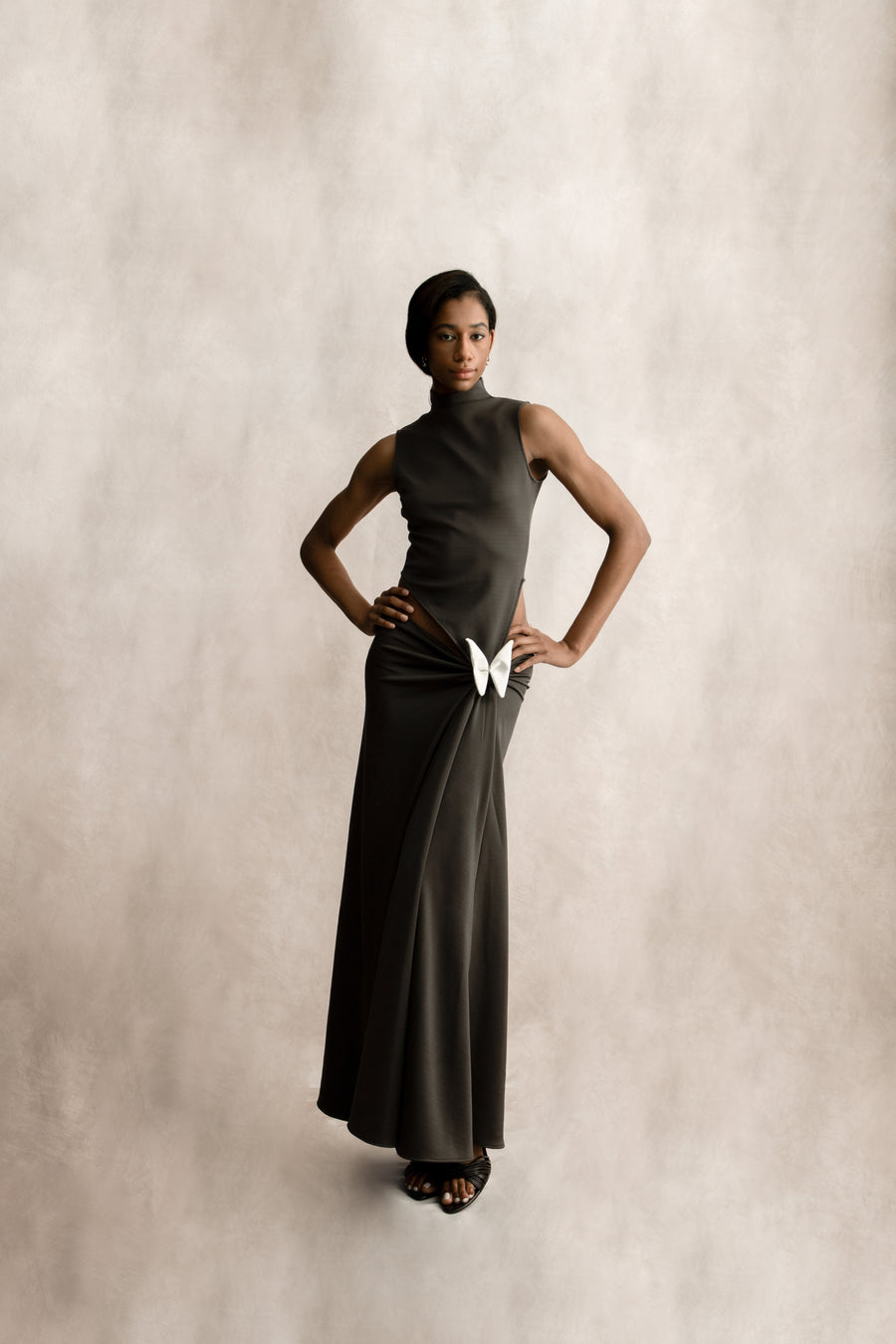
Proportion governs exactly where an observer's eye stops and focuses. By altering the scale and scale of specific design details, such as an asymmetric neckline cutout or a high side split, the designer creates an intentional focal point. In our high-contrast High-Neck Low-Rise Draped Wrap Dress - Graphite, the precise geometric scale of the cutout acts alongside a low-slung waist panel to draw attention across the torso, balancing modest full-coverage lines with dynamic, unexpected openings.
Role 3: Managing Structural Balance and Flow in Fluid Textiles
When working with delicate, fluid fabrics, proportion dictates how the material moves and responds to air currents. A heavy hemline will weight down fine pleats, while an ultra-light finish can cause a silk panel to float too freely. Managing the proportion of fabric weight allows designers to lock in a garment's signature movement, ensuring it flows beautifully as the wearer walks without gathering bulk or losing its intended shape.
Role 4: Introducing Dynamic Tension Through Asymmetric Restraint
Symmetry conveys calm and stability, whereas intentional asymmetry introduces exciting visual movement. Unbalancing horizontal design lines requires sharp structural control to keep the look elegant. Sourcing our sculptural One-Shoulder Low-Rise Draped Dress - Graphite shows how a sharp, singular shoulder line counterbalances a dropped drape at the hip, building a modern look where every fold feels deliberate and secure.
Role 5: Establishing Light Interplay with Textile Overlays
Proportion controls how different layers of fabric reveal or conceal the skin beneath. In fine lace and open-knit garments, the size of the knit pattern dictates how ambient light filters through the material. Our premium Pointelle Knit Sequin Maxi Dress – Ivory balances an intricate, semi-sheer open-knit pattern against a long, modest columnar silhouette, subtly reflecting light with every movement while maintaining an aura of elegant mystery.
Role 6: Building Textural Depth with Articulated Applications
Adding dimensional details like embroidery or appliqués requires precise scale mapping to avoid overwhelming the garment's underlying lines. The size of the decoration must match the surface area of the pattern panel it sits on. Choosing our tailored High-Neck Fitted Tulip Appliqué Dress - Slate shows how carefully sized, hand-placed tulip accents follow the vertical contours of the frame, building rich textural depth without disrupting the dress's clean, streamlined shape.
Role 7: Managing Volume Contrast Across Multi-Layer Sets
Proportion dictates how separate garments layer together within a single look. Pairing a voluminous, oversized coat with wide-leg trousers requires careful balancing to prevent the silhouette from looking heavy or swamped. Designers manage this relationship by keeping the waist or shoulders neatly structured, ensuring the overall look conveys deliberate luxury rather than accidental bulk.
Role 8: Securing Lasting Silhouette Memory and Timeless Presence
The ultimate role of proportion is creating a distinct, memorable look that lingers in the mind long after a social gathering has ended. When a garment's vertical cut lines and volume distribution achieve an ideal structural balance, the silhouette stays clean and defined from every angle. This design discipline creates a powerful, understated presence that bypasses fleeting trends, ensuring the piece remains a timeless staple for meaningful settings.
4. Engineering Precision: Material Memory and Structural Restraint
Achieving real elegance across a limited occasionwear collection requires matching your geometric proportion blueprints with high-durability fabrics that hold their shape through long wear.
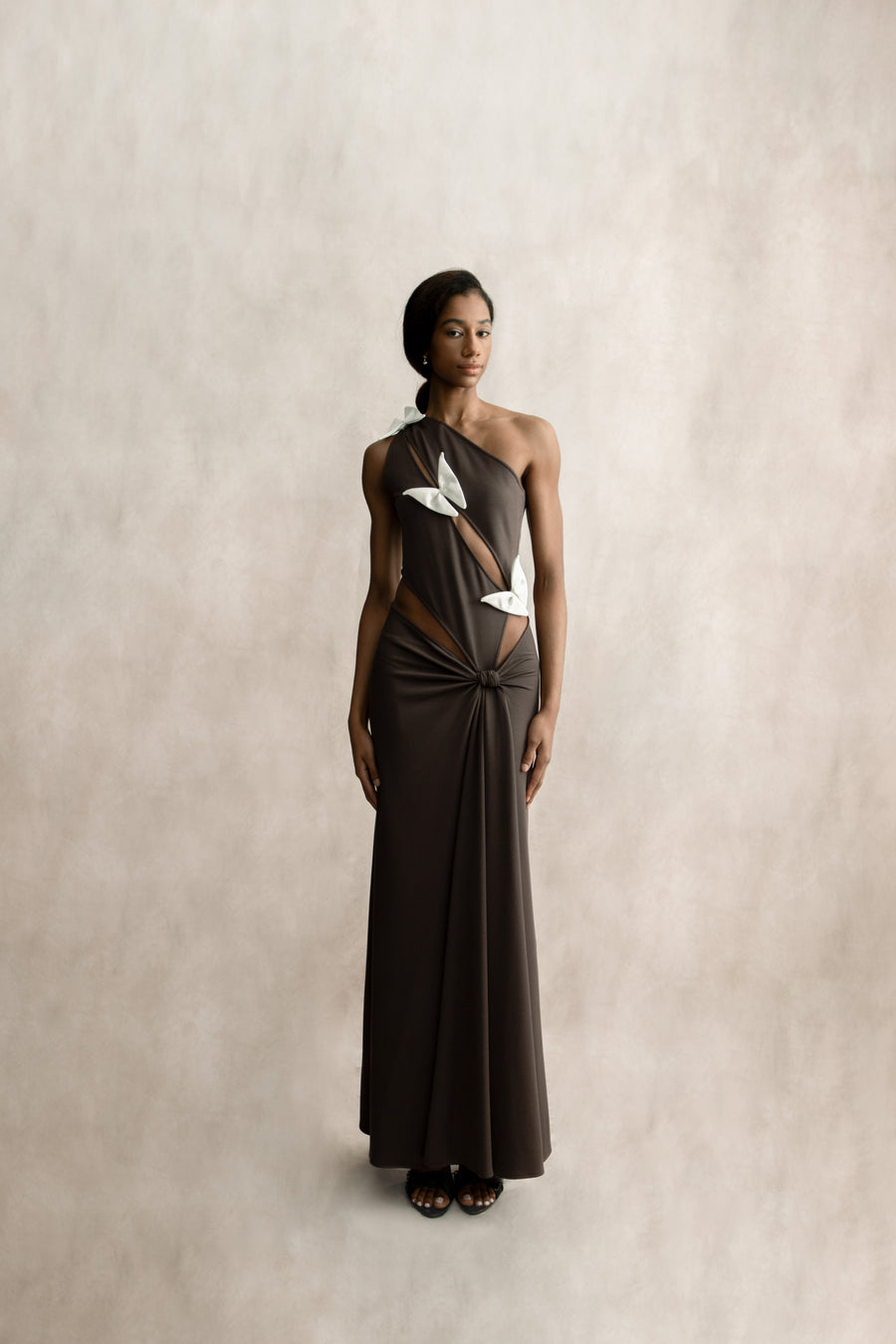
To view our complete line of meticulously balanced silhouettes in soft, rich alternative tones, explore our curated color variations. For clients who prefer subtle, organic tones over classic black, choosing our tailored One-Shoulder Low-Rise Draped Dress – Taupe provides a soft, warm alternative that highlights the dress's asymmetric drape lines beautifully. For high-profile evening events where understated elegance is key, sourcing our high-neck High-Neck Low-Rise Draped Wrap Dress – Taupe delivers a striking, sophisticated style that combines deliberate structural restraint with exceptional silhouette memory.
| HER.I Occasionwear Master Model | Textile Blend & Weight Base | Proportion Architecture Method | Sourcing Platform Resource Link |
|---|---|---|---|
| Pearl-Embellished Lace Maxi | High-purity cotton lace with hand-linked pearls | Classic high-waist elongation with scalloped edges | Pearl Lace Maxi Sourcing |
| Tulip Appliqué Dress - Graphite | Premium crepe matrix with structural appliques | Vertical seam tracing with localized floral placements | Tulip Graphite Sourcing |
| Tulip Appliqué Dress - Taupe | Premium crepe matrix with structural appliques | Vertical seam tracing with localized floral placements | Tulip Taupe Sourcing |
Furthermore, managing the proportion of texture is essential when designing items adorned with delicate surface detailing. For romantic formal settings, our romantic Pearl-Embellished Lace Maxi Dress – Ivory shows how carefully spaced, hand-placed seed pearls enhance the delicate lines of the underlying lace without adding unnecessary weight. Every single piece we produce at HER.I is crafted in limited numbers, ensuring direct, uncompromising quality control that honors your most meaningful life milestones.
5. Frequently Asked Questions (FAQs)
6. Professional Couture and Sizing Design References
For official clothing size systems, pattern engineering protocols, and professional couture history manuals, consult these authoritative organizations:
- International Organization for Standardization. ISO 8559: Garment Construction and Anthropometric Size Designation Systems for Three-Dimensional Pattern Customization. Geneva, Switzerland.
- Fashion Institute of Technology Research Collection. Analysis of Spatial Intervals, Vertical Intersections, and Geometric Drape Dynamics across Twentieth-Century Eveningwear Architectures. New York, NY.
- American National Standards Institute (ANSI). ASTM D5219 Standard Terminology Relating to Body Dimensions for Apparel Sizing Frameworks. Washington, DC.


