


The contemporary luxury landscape demands a sophisticated interrogation of pattern structural integrity, sizing mechanics, and manufacturing scale. For designers and patrons navigating high-end evening spaces, distinguishing between the fields of customized individual dressmaking and mass luxury apparel is critical. This boundary influences design timelines, collection lifecycles, global sourcing strategies, and retail margins. Assessing the core couture vs ready to wear differences reveals that the distinction centers on whether clothing is handled as a single artistic prototype or an optimized, reproducible multi-size collection.

From our experience at HER.I, exploring clothing as an act of quiet power requires an absolute focus on silhouette memory, deliberate restraint, and structural soft-sculpting. The modern luxury patron no longer measures value by excessive surface ornamentation alone. True design dominance depends on masterfully balanced pattern geometry that commands presence across high-stakes settings. In this comprehensive industry analysis, we provide a complete engineering overview of the underlying differences, detail key sourcing metrics, and demonstrate how limited-edition premium occasionwear bridges the gap between artistic customization and scalable distribution networks.
Table of Contents
- 1. Legal and Structural Definitions: Haute Couture vs. Prêt-à-Porter
- 2. Pattern Engineering, Fit Architecture, and Sizing Tolerances
- 3. Textile Sourcing, Component Metallurgy, and Labor Allocation
- 4. Production Economics and Global Supply Chain Discrepancies
- 5. Master Structural Comparison Matrix
- 6. Bridging the Boundary: The HER.I Occasionwear Philosophy
- 7. Frequently Asked Questions (FAQs)
- 8. Scholarly and Regulatory References
1. Legal and Structural Definitions: Haute Couture vs. Prêt-à-Porter
In international fashion law, haute couture is a legally protected term rather than a loose marketing descriptor. Regulated by the Fédération de la Haute Couture et de la Mode, the title is granted exclusively to specific ateliers that comply with strict, decades-old parameters. These parameters require houses to maintain a dedicated workshop in Paris, employ a minimum of fifteen full-time pattern makers and technicians, design fully customized apparel for private clients with multiple mandatory on-site fittings, and present two distinct collections of at least twenty-five original ensembles per year.
Ready to wear, or prêt-à-porter, represents the commercial foundation of international luxury commerce. These lines are manufactured according to standardized size frameworks using automated pattern scaling algorithms. While high-end ready to wear garments maintain luxurious finishing standards and premium fabric choices, they are engineered from the outset to be cut, sewn, and packed in uniform batches. We recommend that luxury retail professionals strictly differentiate these terms to maintain brand authority and provide clear expectations regarding manufacturing timelines and product origins.
2. Pattern Engineering, Fit Architecture, and Sizing Tolerances

The mechanical divergence between these two clothing worlds is clearly visible during the early pattern development stage. A couture piece is draped directly onto a client's personalized physical mannequin or custom dress form. There are no standardized size constraints; the fabric is pinned, cut, and adjusted manually to complement unique bodily curves and movement styles. This individualized tailoring process accommodates physical asymmetries perfectly, distributing fabric weight across the torso with surgical precision.
Ready to wear design relies on advanced software pattern nesting to develop standard sizes from a baseline model. Designers use statistical body measurement data to project shape averages across global regions. To achieve an elegant, comfortable fit across varied body types within these rigid parameters, garments must use creative design elements. We recommend integrating internal structural corsetry, bias-cut structural paneling, and high-recovery lining components to provide a tailored feel across standard industrial sizing systems.
3. Textile Sourcing, Component Metallurgy, and Labor Allocation
The raw materials selected for production highlight another major contrast when examining couture vs ready to wear differences. Couture production utilizes rare, ultra-premium textiles, including custom-woven silk jacquards, delicate French laces, and deadstock hand-dyed tulles. These fabrics are often produced in single digit yardages exclusively for one collection. Labor allocation is concentrated heavily on hand-executed finishes, where individual specialists spend hundreds of hours hand-stitching concealed horsehair hem stabilizers, hand-applying real pearls, or mounting custom embroidery maps onto fragile bases.
Ready to wear sourcing must balance premium luxury aesthetics with predictable industrial performance. Fabric lots must pass extensive testing covering tensile strength, color fastness during washing, and low seam slippage under strain. Designers select luxury materials that can be processed smoothly by high-speed industrial cutting machines and automated sewing lines. Hand applications are replaced by precise machine finishes, lock-stitched seams, and high-tensile metal zippers to ensure the final garment remains durable and easy to maintain throughout its wearing lifecycle.
4. Production Economics and Global Supply Chain Discrepancies
The business models underpinning these two manufacturing paths require completely different approaches to managing inventory and allocating capital. A couture atelier operates as a high-prestige, low-volume service center where products are made exclusively to order. This bespoke setup removes the overhead costs of storing excess retail inventory and eliminates markdowns, but it requires immense upfront capital to sustain skilled workshop labor during long development cycles.
Ready to wear operations follow a traditional wholesale and direct-to-consumer manufacturing calendar. Production orders must be planned months in advance to source raw materials efficiently, secure factory production slots, and coordinate international freight delivery. Success relies on optimizing fabric yield per marker, lowering component assembly times, and maintaining high manufacturing throughput. This retail structure allows luxury houses to scale production from limited runs up to thousands of units, making premium fashion accessible to a global audience.
5. Master Structural Comparison Matrix
To assist fashion historians, sourcing directors, and retail buyers in analyzing the core couture vs ready to wear differences, the following responsive comparison table summarizes the primary design and manufacturing parameters.
| Operational Parameter | Bespoke Haute Couture Systems | Premium Ready to Wear (Prêt-à-Porter) | Strategic Luxury Impact |
|---|---|---|---|
| Legal Governance | Strictly regulated by the French Ministry of Industry | Open industrial production standards | Defines brand prestige and verified collection origins |
| Pattern Creation | Draped manually onto a client's custom dress form | Digitally nested using automated size models | Governs individual fit accuracy and structural movement |
| Labor Configuration | Predominantly hand-stitched by skilled artisans | Advanced high-precision industrial sewing machinery | Determines production speed, capacity, and total turnaround time |
| Textile Multipliers | Bespoke, single-digit exclusive yardage lots | Industrial luxury mill runs with strict testing | Influences material durability and fabric consistency |
| Inventory Risk | Zero excess inventory; strictly custom made-to-order | Batched production runs based on seasonal wholesale targets | Dictates corporate retail margins and capital allocation loops |
| Turnaround Windows | Requires multiple on-site fittings across 3 to 6 months | Immediate shipment following seasonal production runs | Determines delivery speeds for fast-paced events |
6. Bridging the Boundary: The HER.I Occasionwear Philosophy
While understanding historic legal definitions is valuable for fashion analysis, modern occasionwear demands a hybrid approach that blends artisanal care with scalable production systems. HER.I is a modern occasionwear house based in New York, exploring clothing as an act of quiet power. Defined by deliberate restraint, sculptural softness, and silhouette memory, the collections are designed for meaningful settings — where clothing is chosen carefully, worn with intention, and remembered long after the moment has passed. Produced in limited numbers and offered through select retail partners, HER.I approaches occasionwear through precision, restraint, and lasting presence.
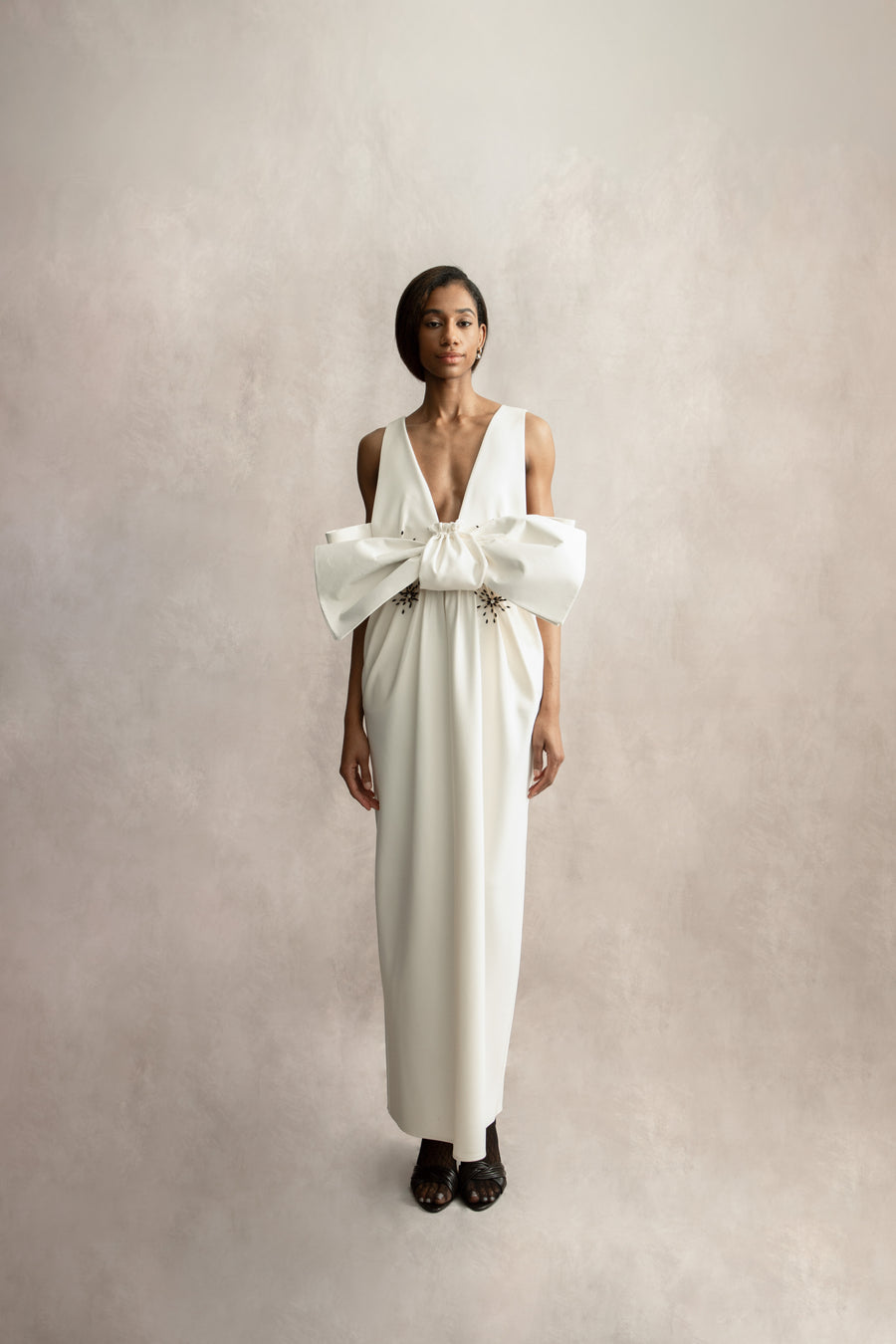
By controlling our production scales and focusing heavily on internal architecture, we create ready-to-wear pieces that capture the exquisite fit and lasting presence of custom-draped evening garments. For patrons seeking a timeless, sculptural look for high-profile gallery openings or modern black-tie events, we recommend exploring our minimalist Deep V Column Gown with Oversized Bow – Ivory B. To experience this architectural column silhouette rendered with a slightly alternative rear construction, brides and curators can view our premium Deep V Column Gown with Oversized Bow – Ivory W.
Furthermore, contemporary lifestyle settings require versatile, adaptable styling choices that transcend simple traditional gown limits. For high-stakes evening dinners or destination events, styling directors can integrate our structural Strapless Two-Piece Wrap Dress – Mimosa. To transition smoothly into classic dark formal aesthetics while maintaining clean geometric panels, curators can explore our dramatic Strapless Two-Piece Wrap Gown – Noir.
For settings that demand high visual definition and impeccable fit architecture, we recommend utilizing built-in internal structure to lock fabric lines into place. Design teams can explore our vibrant Strapless Corset Fitted Slit Dress - Cyanite Blue, or view subtle, muted expressions of the same silhouette by browsing our Strapless Corset Fitted Slit Dress – Mist Blue array. Finally, to design a complete multi-texture wardrobe for long evening events, collections can be enhanced by incorporating our intricately knit Pointelle Knit Sequin Maxi Dress – Ivory alongside the elegant, classic texture of our Pearl-Embellished Lace Maxi Dress – Ivory to establish a memorable, refined presence.
7. Frequently Asked Questions (FAQs)
8. Scholarly and Regulatory References
1. Fédération de la Haute Couture et de la Mode. (2024). Statutes and Governance Rules Governing Membership and Technical Classifications for Haute Couture Ateliers in Paris. Available via the academic repository at https://www.fhcm.paris/)
2. International Journal of Fashion Design, Technology and Education. (2025). Analysis of Digitized Pattern Nesting, Anthropometric Sizing Models, and Seam Slippage Tolerances in Industrial Luxury Prêt-à-Porter Lines. Apparel Engineering Database.
3. French Ministry of Industry. (2023). Decree on Protection of Artisanal Fashion Design Appellations and Intellectual Property Governance in Occasionwear Production. Government Legal Information Network.


