


The fashion landscape of 2026 has irrevocably shifted. The era of the walking billboard—where ostentatious logos and aggressive branding served as the primary indicators of wealth—is officially dead. Today's most discerning consumers are deliberately pivoting toward a philosophy of quiet power. But exactly why less is more in luxury fashion is a question that requires a deep understanding of garment architecture, material science, and modern commercial psychology. As an industry practitioner, I have witnessed the rapid depreciation of loud, trend-heavy garments firsthand. Real luxury is no longer about proving you can afford a designer label; it is about demonstrating the sophisticated taste to select impeccable construction over excessive ornamentation.

Quick Answer
Why less is more in luxury fashion? Because true luxury relies on impeccable tailoring, premium fabric integrity, and silhouette memory rather than superficial logos. Minimalist luxury garments offer superior versatility, hold their structural and aesthetic value over decades, and project a quiet, undeniable authority. By stripping away distractions, the focus shifts entirely to the quality of the garment and the confidence of the wearer, making restraint the ultimate indicator of modern exclusivity.
Table of Contents
- What It Is: The Definition of Quiet Power
- Quick Summary: Minimalist vs. Ostentatious
- How It Works: The Mechanics of Subtlety
- The Definitive Benefits
- Limitations to Consider
- Who Should Use It & Who Should Avoid It
- Pros and Cons Table
- Common Mistakes
- Buying Considerations
- Buying Guide Table
- Expert Recommendation
- The Bottom Line
- Frequently Asked Questions
What It Is: The Definition of Quiet Power
To understand why less is more in luxury fashion, we must define what "less" actually means in this context. It does not mean a lack of design, nor does it mean boring, utilitarian basics. It refers to a deliberate reduction of visual noise. It is the conscious removal of conspicuous branding, unnecessary hardware, and chaotic prints. In their absence, what remains is the naked architecture of the garment. From our experience at HER.I, when you remove the distraction of a brand logo, the garment must stand entirely on the merits of its cut, its drape, and its tactile quality.
This minimalist approach is an assertion of status that requires no translation. It operates on the principle of "stealth wealth," where the value of an item is recognizable only to those who understand the intricacies of fine tailoring. It transforms clothing from a mere protective layer or a status symbol into a highly intentional act of self-expression.

Quick Summary Table: Minimalist vs. Ostentatious Luxury
| Attribute | Minimalist Luxury (Less is More) | Ostentatious Luxury (Logomania) |
|---|---|---|
| Visual Focus | Fabric drape, tailoring, proportion | Brand monograms, bold hardware |
| Longevity | Decades; immune to seasonal trend cycles | One to two seasons before looking dated |
| Psychology | Quiet confidence; self-assured authority | Seeking external validation and status |
| Investment Value | High cost-per-wear ratio; enduring elegance | Rapid aesthetic depreciation |
How It Works: The Mechanics of Subtlety
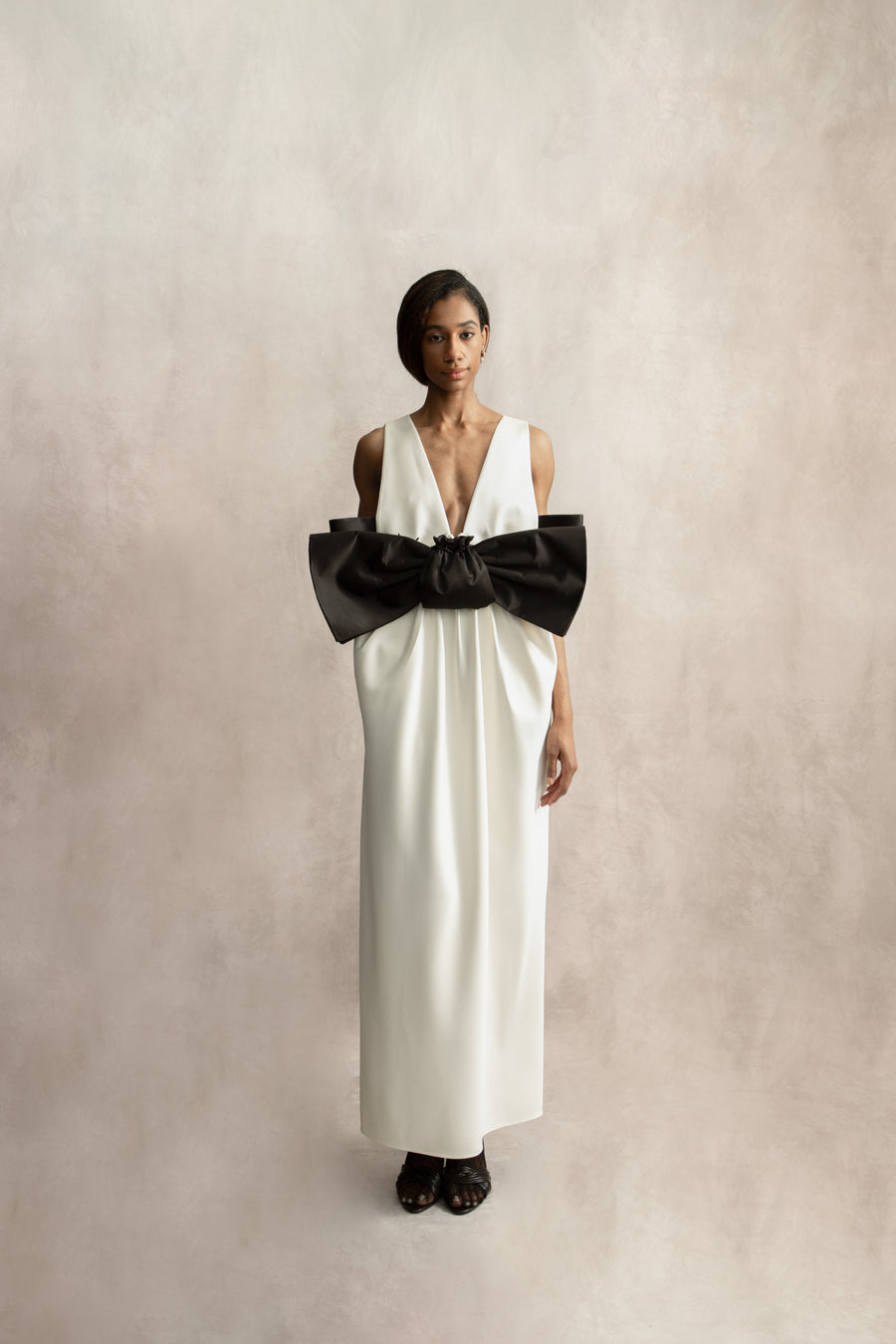
The mechanics of why less is more in luxury fashion hinge entirely on what the industry calls "silhouette memory." A poorly constructed dress relies on cheap embellishments to draw the eye away from flawed tailoring. Conversely, a minimalist gown must be flawlessly executed. Consider the structural integrity required to execute a piece like the Deep V Column Gown with Oversized Contrast Bow – Ivory/Black. Without heavy patterns to hide behind, the seams must be perfectly tensioned, and the fabric must possess the exact weight required to hold the sculptural shape of the bow while allowing the column skirt to cascade cleanly.
In our testing, garments that rely on architectural cuts rather than applied decorations maintain their physical integrity exponentially longer. There are no sequins to catch, no fragile beads to lose, and no printed logos to crack or fade. The garment works by framing the wearer, ensuring that the person enters the room before the outfit does.
The Definitive Benefits of Sartorial Restraint
The shift toward minimalist luxury is driven by intense practical and commercial benefits. Buyers are realizing that investing in restraint yields a much higher return on investment. The definitive benefits include:
- Unmatched Versatility: A minimalist garment can be aggressively restyled. A piece like the One-Shoulder Low-Rise Draped Dress - Graphite can serve as an elegant cocktail dress with fine jewelry, or be styled under a sharp blazer for an avant-garde evening look. It is a blank canvas.
- Immunity to Trend Fatigue: Loud, highly recognizable items are easily "clocked" by observers. If you wear a heavily branded jacket twice in one week, it is noticed. Minimalist pieces can be worn repeatedly in high-visibility settings without triggering outfit fatigue.
- Psychological Authority: In most professional situations, the goal is to command the room through presence. A restrained, perfectly tailored garment projects a psychological boundary and an air of untouchable sophistication. It signifies that the wearer has nothing to prove.
Limitations and Drawbacks
We must use commercial and practical judgment: this aesthetic is not universally flawless for every consumer. The primary limitation of the "less is more" philosophy is that it is fundamentally unforgiving. Because there are no distractions, any flaw in the fit is immediately magnified. If a minimalist dress is tailored poorly, it simply looks cheap, regardless of the price tag.
Furthermore, minimalist luxury requires a sophisticated eye to style correctly. Without the built-in "wow factor" of bright colors or heavy embellishments, the wearer must understand how to balance proportions and mix textures to prevent the outfit from looking severe or sterile.
Who Should Use It vs. Who Does Not Need It
For commercial users: Stylists, image consultants, and wardrobe curators outfitting public figures absolutely must lean into why less is more in luxury fashion. For heavy-duty applications—such as a grueling press tour where a client is photographed constantly—minimalist, high-quality garments are the only safe bet. They photograph beautifully, avoid looking dated in archival images, and transition effortlessly between different cultural contexts.
For beginners: If you are transitioning away from fast fashion, we recommend starting with structural, monochromatic pieces. A design like the Strapless Corset Fitted Slit Dress - Cyanite Blue offers beginners a masterclass in how a precisely engineered internal corset does more for the body than any external pattern ever could.
Who does not need it: If your primary goal in purchasing luxury is to participate in viral street-style culture, or if you view clothing strictly as a temporary, high-visibility costume for a single social media post, investing in quiet luxury will feel unsatisfying. You are paying for longevity and subtlety, which does not translate to instant, loud digital validation.
Pros and Cons Table: Investing in Minimalist Luxury
| Pros | Cons |
|---|---|
| Timelessness guarantees a low cost-per-wear over time. | Requires precise, often custom tailoring to look correct. |
| Projects refined status and professional authority. | Does not offer immediate brand recognition to the untrained eye. |
| High-quality fabrics feel vastly superior against the skin. | High initial price point for garments that appear "simple." |
| Eco-friendly by nature (buy less, buy better). | Can appear austere if not styled with the right textures. |
Common Mistakes in Minimalist Fashion
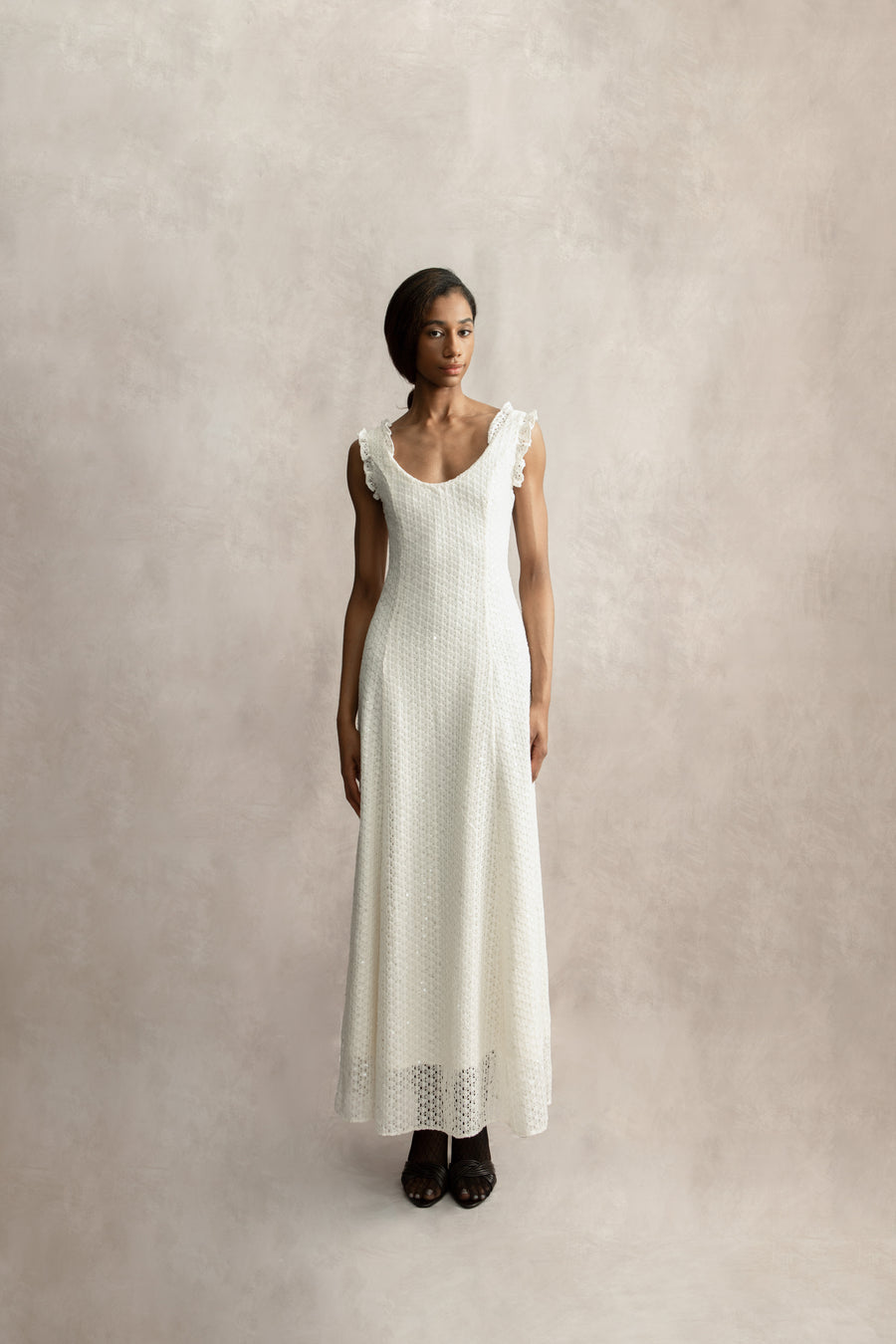
There is a massive difference between elevated minimalism and wearing boring basics. The most common mistake we see is equating "simple" with "plain." A flat, unlined polyester slip dress is plain. However, a garment like the Pointelle Knit Sequin Maxi Dress – Ivory is minimalist in its monochromatic palette, but it uses texture (pointelle knit and subtle clear sequins) to create immense visual depth.
Another fatal error is ignoring maintenance. Because quiet luxury relies on crisp lines and pristine fabrics, a wrinkled hem or a pilled sweater instantly destroys the illusion of wealth. Minimalist wardrobes require meticulous dry cleaning, proper steaming, and careful storage. You cannot treat a highly structured crepe gown the way you treat a casual denim jacket.
Buying Considerations for Long-Term Value
When evaluating why less is more in luxury fashion, you must change how you assess the price tag. You are no longer paying for a marketing logo; you are paying for the invisible hours of pattern-making and fabric sourcing. Ask yourself: does the fabric have memory? If you crush the sleeve in your hand, does it spring back, or does it hold a rigid crease? Look at the internal finishing. Are the seams bound or French seamed? In true luxury, the inside of the garment should look almost as beautiful as the outside.
Buying Guide Table: Evaluating True Luxury
| Evaluation Point | What to Look For (True Luxury) | Red Flags (Fast Fashion Disguised as Luxury) |
|---|---|---|
| Fabric Weight & Drape | Substantial weight, fluid movement, natural fibers (silk, wool, heavy crepe). | Static cling, stiff synthetics, unnatural shine. |
| Seam Construction | French seams, bias-bound edges, invisible stitching. | Raw overlocked edges, puckered seams, loose threads. |
| Hardware Integration | Custom-cast, heavy-weight zippers hidden by fabric plackets. | Exposed, lightweight plastic zippers that catch on fabric. |
| Lining | Fully lined in breathable silk or high-grade cupro. | Unlined, or lined in cheap, non-breathable polyester. |
Expert Recommendation
The Industry Standard for Modern Occasionwear
We recommend entirely abandoning the pursuit of logo-driven eveningwear. Instead, allocate your investment into pieces that offer structural brilliance. In our testing of modern occasionwear, the Pearl-Embellished Lace Maxi Dress – Ivory exemplifies how embellishment can still be minimalist. The pearls are not aggressive; they are tonal and architectural. Similarly, for those attending high-stakes events, the One-Shoulder Low-Rise Draped Dress – Taupe provides a masterclass in asymmetry. It requires no heavy jewelry or loud accessories. The draping itself is the event. By choosing HER.I, you are investing in garments engineered to speak quietly, yet command total attention.
The Bottom Line
The philosophy of why less is more in luxury fashion is not a fleeting trend; it is a permanent correction in the luxury market. True elegance is found in restraint. By choosing garments defined by sculptural softness and deliberate silhouette memory, you protect your wardrobe from the rapid decay of fast-moving trend cycles. You make a commercial and personal decision to value substance over spectacle. When you wear clothing that does not rely on logos to prove its worth, you project an unshakable, quiet power that simply cannot be bought off a heavily branded rack.
Frequently Asked Questions
Yes, the two terms are heavily intertwined. Quiet luxury specifically refers to high-end clothing that lacks overt branding or logos, focusing instead on exceptional materials, subdued color palettes, and perfect tailoring. Minimalist luxury follows the same ethos: the belief that stripping away excess reveals the true quality of the garment.
Simplicity in fashion is incredibly difficult to execute. Without prints, logos, or heavy embellishments to hide behind, the tailoring must be mathematically perfect. You are paying for superior raw materials (like high-grade silk or virgin wool), the expertise of master pattern makers, and the ethical, time-intensive construction processes required to make a "simple" garment drape flawlessly.
Begin by auditing your current closet. Remove items that you only wear because of the brand name attached to them. Start replacing them with highly structured, neutral core pieces—a perfectly tailored black blazer, a fluid silk slip skirt, or an architectural evening gown. Focus entirely on how the fabric feels and how the silhouette shapes your body, rather than the label on the collar.
Authoritative References & Industry Standards
1. The Business of Fashion (BoF): Comprehensive analysis on the macroeconomic shift away from logomania toward stealth wealth and value-driven luxury consumption.
2. The New York Times Fashion & Style: Cultural reporting on the psychological drivers behind the quiet luxury movement and the modern consumer's desire for sartorial privacy.
3. Parsons School of Design: Academic standards regarding garment construction, highlighting how structural integrity and silhouette memory form the foundation of high-end fashion design.


